
The Making of the Indian Constitution: A Chronological Journey under the Chairmanship of Dr. B. R. Ambedkar
Introduction
The Constitution of India is the backbone of the world’s largest democracy. It defines how the country is governed, protects the rights of citizens, and establishes the duties of the state. The making of the Constitution was not a sudden event but the result of a long historical process involving debates, discussions, and contributions from many leaders.
Among these leaders, B. R. Ambedkar played a crucial role as the Chairman of the Drafting Committee. His legal knowledge, social vision, and dedication helped shape the modern Indian republic. The Constitution was adopted on 26 November 1949 and came into effect on 26 January 1950, marking the birth of India as a sovereign democratic republic.
This blog explains the chronological history of the making of the Indian Constitution in simple language so that every reader can understand how this historic document came into existence.
Background: Need for a Constitution
Before independence, India was governed by British laws. The most important among them was the Government of India Act 1935, which provided administrative structure but did not give complete democratic rights to Indians.
Indian leaders wanted a Constitution that would:
- Guarantee fundamental rights
- Ensure democracy
- Establish rule of law
- Protect social equality
The demand for a constitution prepared by Indians themselves became stronger during the freedom movement led by Mahatma Gandhi, Jawaharlal Nehru, and other national leaders.
The Idea of a Constituent Assembly (1934–1946)
The idea of forming a Constituent Assembly was first proposed in 1934 by M. N. Roy, a revolutionary thinker.
Later, the Indian National Congress officially demanded a Constituent Assembly in 1935. The British government initially rejected the idea.
However, during World War II, political pressure increased. In 1946, the British government accepted the proposal through the Cabinet Mission Plan.
This plan allowed Indians to form a Constituent Assembly to draft their own Constitution.
Formation of the Constituent Assembly (1946)
The Constituent Assembly of India was formed in December 1946.
Key Facts
- Total members: 389
- Representatives from British provinces and princely states
- Members were indirectly elected by provincial legislatures
The first meeting was held on 9 December 1946.
The oldest member, Sachchidananda Sinha, served as the temporary chairman.
Later, Rajendra Prasad was elected as the permanent President of the Constituent Assembly.
Objective Resolution (1947)
On 13 December 1946, Jawaharlal Nehru introduced the Objective Resolution in the Assembly.
This resolution laid the foundation for the Constitution and declared that India would become:
- A sovereign republic
- A democratic nation
- A country guaranteeing justice, equality, and freedom
The resolution was adopted on 22 January 1947.
Later, this became the Preamble of the Indian Constitution.
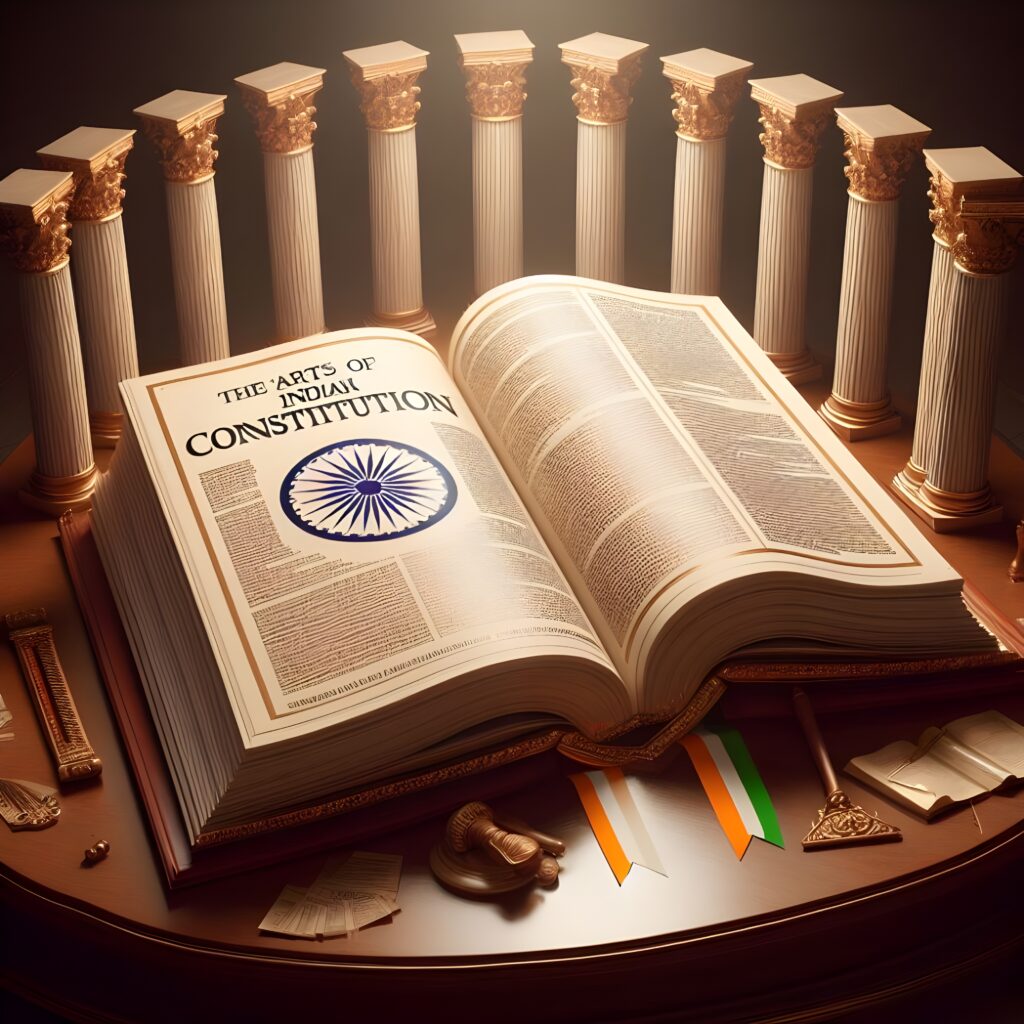
The Indian constitution
Impact of Partition (1947)
In 1947, India was partitioned into two countries:
- India
- Pakistan
This happened through the Partition of India.
Because of partition:
- Many members from areas that became Pakistan left the Assembly.
- The total membership reduced from 389 to 299.
Despite the difficulties and communal violence during partition, the Assembly continued its work on drafting the Constitution.
Formation of the Drafting Committee (1947)
One of the most important steps in the constitution-making process was the formation of the Drafting Committee.
On 29 August 1947, the Constituent Assembly formed this committee.
Chairman of the Drafting Committee
The chairman was B. R. Ambedkar, one of the greatest constitutional experts and social reformers of India.
Other Members Included
- N. Gopalaswami Ayyangar
- Alladi Krishnaswami Ayyar
- K. M. Munshi
- Mohammad Saadulla
- B. L. Mitter
- D. P. Khaitan
The committee’s task was to prepare the draft Constitution based on discussions and decisions of the Assembly.
Role of Dr. B. R. Ambedkar
As chairman, B. R. Ambedkar played a central role in shaping the Constitution.
He carefully studied many constitutions of the world, including those of:
- United States
- United Kingdom
- Ireland
- Canada
- Australia
Based on these studies, he helped design a system suitable for India’s diverse population.
Ambedkar also strongly advocated for:
- Fundamental Rights
- Social equality
- Protection of minorities
- A strong central government
Because of his contributions, he is widely known as the “Architect of the Indian Constitution.”
Preparation of the Draft Constitution (1948)
The first draft of the Constitution was prepared by B. R. Ambedkar and the Drafting Committee.
It was presented to the Assembly in February 1948.
The draft was published for public discussion. Citizens, scholars, and organizations were invited to give suggestions.
More than 7,000 amendments were proposed during discussions.
Debates and Discussions in the Assembly (1948–1949)
The Constituent Assembly held detailed debates on every article of the Constitution.
Members discussed issues such as:
- Fundamental rights
- Citizenship
- Federal structure
- Language policy
- Judiciary
- Minority protection
These debates lasted nearly three years.
The Assembly met for 11 sessions over 165 days of debate.
Many important leaders participated in these discussions including:
- Sardar Vallabhbhai Patel
- Jawaharlal Nehru
- Maulana Abul Kalam Azad
- Hansa Mehta
- Sarojini Naidu
Adoption of the Constitution (1949)
After long discussions and revisions, the final Constitution was adopted on 26 November 1949.
On this historic day, the Constituent Assembly of India officially approved the Constitution.
The document contained:
- 395 Articles
- 8 Schedules
At that time, it was the longest written constitution in the world.
Enforcement of the Constitution (1950)
Although adopted in 1949, the Constitution came into force on 26 January 1950.
This date was chosen because it marked the anniversary of the Purna Swaraj Declaration of 1930, when the Indian National Congress demanded complete independence from British rule.
On that day:
- India became a Republic
- Rajendra Prasad became the first President of India
- The British monarch ceased to be the head of state.
Key Features of the Indian Constitution
The Constitution introduced many important features:
1. Fundamental Rights
These rights protect citizens from discrimination and injustice.
Examples include:
- Right to equality
- Right to freedom
- Right against exploitation
- Right to constitutional remedies
2. Parliamentary Democracy
India adopted a parliamentary system similar to the United Kingdom, where the government is responsible to the parliament.
3. Federal System
Power is divided between:
- Central Government
- State Governments
4. Independent Judiciary
The Constitution established the Supreme Court of India as the highest court to protect the Constitution.
5. Universal Adult Franchise
Every citizen above 18 years has the right to vote regardless of caste, religion, gender, or wealth.
This was a revolutionary step for a newly independent country.
Why the Indian Constitution is Unique
The Constitution of India is unique because it combines ideas from many global constitutions while addressing India’s social realities.
It balances:
- Democracy
- Social justice
- Economic welfare
- Individual freedom
Through this document, India aimed to create a society based on liberty, equality, and fraternity—principles strongly emphasized by B. R. Ambedkar.
Contribution of Ambedkar to Social Justice
Beyond drafting legal provisions, B. R. Ambedkar ensured the Constitution addressed deep social inequalities.
He introduced provisions for:
- Abolition of untouchability
- Reservation for Scheduled Castes and Scheduled Tribes
- Protection of civil liberties
These provisions aimed to build a more inclusive and fair society.
Conclusion
The making of the Indian Constitution was a historic achievement. It was not just a legal document but a vision for a new nation.
Under the leadership of B. R. Ambedkar, the Drafting Committee transformed years of discussions into a structured constitution that continues to guide India today.
Even after more than seventy years, the Constitution remains the foundation of Indian democracy. It protects the rights of citizens, ensures the rule of law, and provides a framework for governance in a diverse country.
Understanding the history behind this document helps us appreciate the sacrifices, ideas, and wisdom of the leaders who shaped modern India.
Categories
- Indian Constitution
- Indian History
- Political Science
- Civic Education
Tags
Indian Constitution, Constitution of India history, BR Ambedkar constitution, Constituent Assembly India, drafting committee India, Indian democracy, Ambedkar contribution, Indian political history, constitution making process, republic of India
References
- The Constitution of India – Government of India
- Annihilation of Caste by B. R. Ambedkar
- Debates of the Constituent Assembly of India (1946–1949)
- Ministry of Law and Justice, Government of India
.

Nice 👍
Very good
Super 👍
Good 👍
Nice sir
Very nice
Good 👍
Very nice
Sahi hai
Good 👍
Super se super
Very nice
Nice 👍👍👍👍👍👍👍👍👍👍👍👍👍👍👍👍
Good
Very very nice 💯💯💯💯💯💯
Super se super 👍👍👍👍👍
Nice
Best best 👍
Very nice 🙂🙂🙂🙂🙂🙂
Nice nice nice nice nice nice nice nice nice nice nice nice nice nice nice nice nice nice nice nice nice nice pinky
Mast mast mast mast
Good 👍
Kya baat hai sir
Best best 👍👍👍👍👍