India’s Education Reality vs Attractive Policies: Where Are We Heading?
Introduction
Both Central and State Governments in India regularly announce attractive educational schemes. Many of these programs are inspired by the education systems of countries like China, the USA, Japan, and South Korea. Almost every week, a new policy, portal, app, or scholarship is launched. On paper, everything looks impressive. But the real question remains: Do we have the infrastructure, qualified teachers, and home support to make these programs successful?
This gap between policy and ground reality is creating serious challenges for students, parents, and the nation as a whole.
Policy Copying Without Ground Preparation
Countries like China, Japan, South Korea, and the USA built their education systems over decades. They invested heavily in schools, laboratories, digital infrastructure, teacher training, and discipline before expecting results.
In India, many policies are introduced quickly without proper preparation. Schools lack basic classrooms, libraries, science labs, and digital tools. Teachers are often overburdened with administrative work instead of teaching. As a result, even well-designed programs fail to create real learning outcomes.
Shortage of Qualified and Motivated Teachers
Teachers are the backbone of any education system. Unfortunately, many schools face:
- Shortage of trained teachers
- Poor teacher-student ratio
- Outdated teaching methods
- Lack of regular skill upgrading
In advanced countries, teachers receive continuous training and respect. In India, teaching is often treated as a fallback career. Without motivated and skilled teachers, no education reform can succeed.
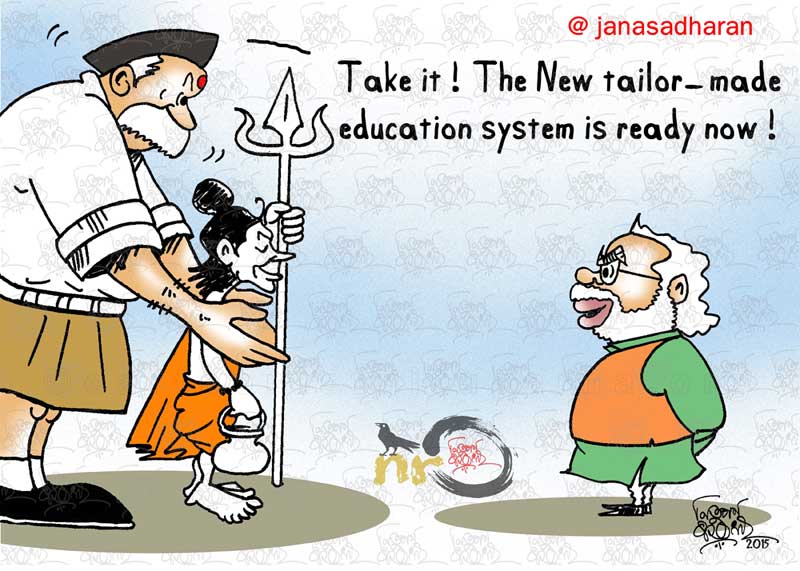
Religion is the big hurdle in present educatinal system
Student Home Infrastructure: The Missing Link
Government policies assume that students have access to:
- Internet and Wi-Fi
- Laptop or desktop computers
- Quiet study environment
But reality is different. Most students only have Android mobile phones, often shared with family members. Online classes, digital homework, and virtual labs become ineffective on small screens.
Excessive mobile use leads to:
- Poor attention span
- Addiction to short videos and games
- Low reading habits
- Weak thinking and reasoning skills
Instead of learning, many students spend free time scrolling, laughing alone, and consuming meaningless content.
Lack of Vision, Mission, and Guidance
A major concern is that many students today do not have a clear vision for the next 2 to 4 years. Career guidance is missing at school and home levels.
Problems include:
- Poor general knowledge (GK)
- Low critical thinking ability
- Weak communication skills
- No exposure to real-world careers
Parents often leave everything to schools while focusing only on earning money, buying property, or cars. Emotional bonding, discipline, and mentoring are ignored.
Health, Nutrition, and Cognitive Decline
India has a rapidly growing population, especially children aged 5 to 18 years. However, many suffer from:
- Malnutrition
- Anemia
- Poor immunity
- Frequent illness
- Low cognitive development
Good education cannot happen without good health. Poor nutrition directly affects memory, attention, and learning capacity. Playing cricket in street corners is healthy, but it cannot replace balanced education, discipline, and intellectual growth.
Employment Scenario: Next 4 Years
If the current situation continues, the employment scenario may become alarming:
- More degrees, fewer skills
- High unemployment among educated youth
- Growth of low-paying, unstable jobs
- Increased frustration and mental stress
Automation and Artificial Intelligence are already reducing traditional jobs. Without skill-based education, millions of young people may become unemployable.
India’s Overall Situation: A Warning Signal
India has a young population, which is a strength only if it is educated, skilled, healthy, and disciplined. Otherwise, it can turn into a social and economic burden.
Key risks include:
- Rising inequality
- Social unrest
- Skill mismatch
- Increased dependency ratio
Education reforms must focus on quality over quantity, teachers over technology, and students over statistics.
The Way Forward
To improve the situation, India needs:
- Strong school infrastructure
- Continuous teacher training
- Affordable digital access for students
- Nutrition and health programs
- Career counseling from early classes
- Active parental involvement
Education is not just about policies. It is about people, purpose, and preparation.
Conclusion
Attractive educational programs alone cannot transform a nation. Without infrastructure, trained teachers, supportive families, and healthy students, these schemes remain only on paper. India must act now to bridge the gap between vision and reality, or the next generation will pay a heavy price.
Meta Description
India launches attractive education schemes, but lacks teachers, infrastructure, digital access, and student guidance. Learn the real impact on employment and future growth.
Focus Keywords
Indian education system, education infrastructure India, teacher shortage India, student digital divide, future employment India, population growth education, skill-based learning India
Disclaimer
This article is for informational and educational purposes only. It reflects general observations and does not target any individual, institution, or government authority.