
How DNA Shape Aptitude vs Attitude: How Nature and Environment Shape Human Life
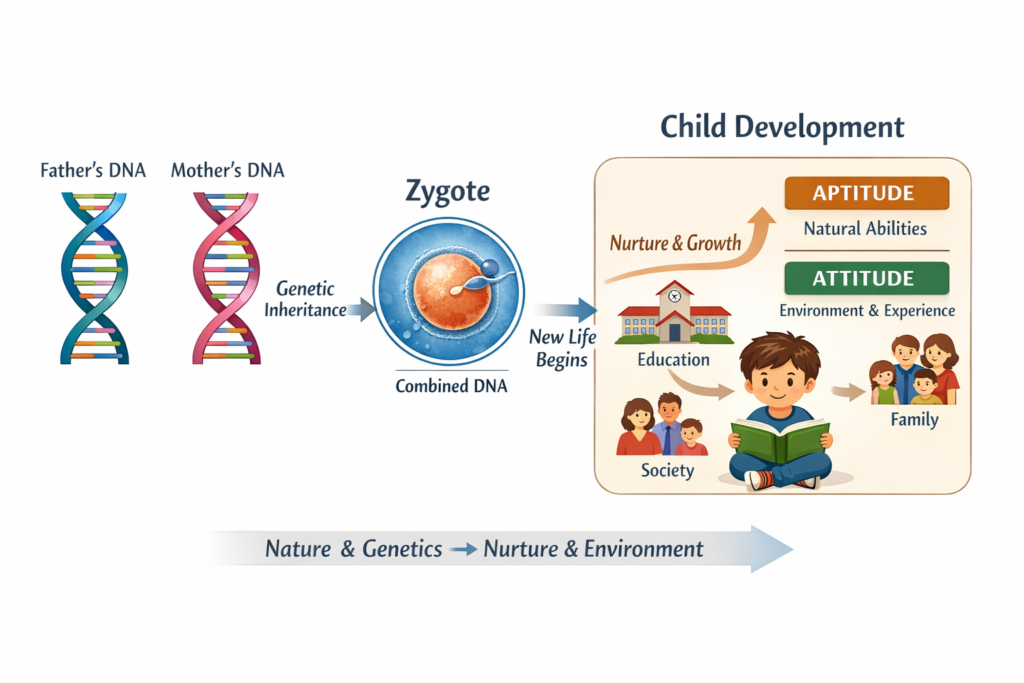
How DNA shapes aptitute and attitute
Introduction
Human personality is a complex combination of biological inheritance and environmental influence. From birth, every child carries a unique genetic blueprint inherited from parents, yet as life progresses, individual interests, abilities, and behaviors often differ significantly from those of the parents. This raises an important question: Are aptitude and attitude determined by DNA, or are they shaped by environment and personal experiences?
Understanding the difference between aptitude and attitude helps explain how people develop talents, beliefs, and behavior patterns. This article explores the relationship between genetics, environment, and personal will in shaping human life.
What is Aptitude?
Aptitude refers to a person’s natural ability or potential to learn or perform certain tasks. It is an inborn capacity that makes it easier for someone to develop particular skills.
For example:
- A child may naturally grasp mathematics quickly.
- Another child may show talent in music or art.
- Some individuals may possess strong analytical or logical thinking abilities.
Aptitude does not guarantee success; rather, it indicates the potential to learn something faster or more effectively than others when given proper training and opportunities.
Psychologists often assess aptitude through aptitude tests, which help identify strengths in areas such as reasoning, language, mechanical ability, or creativity.
What is Attitude?
Attitude refers to a person’s mental outlook, beliefs, and emotional responses toward people, situations, or life events.
Unlike aptitude, attitude is not fixed at birth. It develops gradually through:
- Family environment
- Education
- Cultural influences
- Social interactions
- Personal experiences
For instance:
- A positive attitude helps people handle difficulties with resilience.
- A negative attitude may lead to frustration and conflict in relationships.
Attitude influences how individuals respond to opportunities and challenges in life.
The Role of Genetics in Aptitude
Every human life begins with a zygote, which is formed when a sperm from the father fertilizes an egg from the mother. This single cell carries genetic material (DNA) from both parents.
DNA contains genes that determine many biological traits such as:
- Physical appearance
- Certain cognitive abilities
- Temperament tendencies
Scientists in the field of behavioral genetics suggest that some aspects of intelligence and aptitude have a hereditary component. For example, research shows that cognitive abilities can partly run in families.
However, genes only provide potential, not destiny. A child may inherit certain abilities but still require training, education, and practice to develop them.
Why Children Are Different from Their Parents
Although children inherit genes from both parents, they do not become exact replicas. This happens because:
1. Genetic Recombination
During reproduction, genes from parents mix in unique combinations. As a result, each child receives a different genetic pattern, even among siblings.
2. Environmental Influence
The environment plays a powerful role in shaping behavior and talents. A child raised in a supportive environment may develop skills that parents never had.
3. Personal Interest and Motivation
Individual curiosity and motivation influence how talents develop. A child may choose different interests based on exposure and experiences.
Therefore, while genetics provides a biological foundation, life experiences determine how those abilities grow.
DNA Differences Between Parents and Children
Each person has a unique DNA structure, even though half of the genetic material comes from each parent.
Key points about DNA inheritance:
- A child receives 50% of DNA from the mother and 50% from the father.
- Genes combine in unpredictable ways, creating a new genetic identity.
- Small variations in DNA contribute to differences in personality, intelligence, and preferences.
Because of this genetic uniqueness, no two individuals are exactly alike, except identical twins.
Environment and the Development of Attitude
While aptitude may have some genetic basis, attitude is largely shaped by environment.
Important environmental influences include:
Family Environment
Children learn behaviors and emotional responses by observing parents and caregivers.
Social Interaction
Friends, teachers, and community influence how individuals perceive the world.
Education
Education helps shape critical thinking, discipline, and moral values.
Cultural Background
Culture defines norms, values, and behavioral expectations.
These factors collectively influence how a person develops attitudes toward life.
Can Attitude Change Life?
One of the most powerful aspects of human psychology is the ability to change attitude.
Unlike genetic traits, attitudes are flexible. A person can transform their life by changing how they think and react to situations.
Psychological research shows that positive attitudes can improve:
- Mental health
- Relationships
- Professional success
- Problem-solving abilities
A well-known principle in psychology states that behavior often follows belief. When individuals develop constructive thinking patterns, their actions and outcomes also change.
Conflict and Differences Among Humans
Human conflicts often arise from differences in beliefs, expectations, and personalities.
Part of these differences comes from:
- Unique genetic traits
- Individual upbringing
- Cultural variations
- Personal experiences
Since every person has a unique biological and social background, disagreements are natural in society.
However, harmony can be achieved through attitudes such as:
- Patience
- Mutual respect
- Compromise
- Understanding
- Cooperation
The philosophy of “live and let live” encourages tolerance and peaceful coexistence despite differences.
The Balance Between Nature and Nurture
Psychologists often describe human development through the nature vs nurture debate.
- Nature refers to genetic inheritance.
- Nurture refers to environmental influence.
Modern science suggests that both factors work together.
For example:
- A child may have genetic potential for music.
- But without exposure to instruments or training, that talent may never develop.
Thus, genetics provides possibility, while environment provides opportunity.
Lessons for Parents and Society
Understanding aptitude and attitude has important implications.
Encourage Individual Talents
Parents should observe children’s natural abilities rather than forcing them into predetermined careers.
Create Supportive Environments
Positive environments help children develop both skills and healthy attitudes.
Avoid Excessive Pressure
Pressure may suppress creativity and emotional growth.
Promote Respect and Cooperation
Teaching empathy and patience helps reduce social conflict.
By nurturing both aptitude and attitude, society can help individuals reach their full potential.
Conclusion
Human life is shaped by a delicate interaction between genetics and environment. Aptitude represents the natural abilities that individuals may inherit through DNA, while attitude develops gradually through life experiences and social interactions.
Although genetic inheritance plays a role in shaping abilities, it does not determine destiny. Individuals have the power to transform their lives by cultivating positive attitudes, resilience, and adaptability.
In the end, peace and harmony in society depend not only on biological differences but also on how people choose to treat one another—with patience, understanding, and mutual respect.
References
- Plomin, R., DeFries, J., Knopik, V., & Neiderhiser, J. (2016). Behavioral Genetics. Worth Publishers.
- Santrock, J. W. (2018). Child Development. McGraw-Hill Education.
- American Psychological Association – Human Development and Genetics Research.
- National Institutes of Health (NIH) – Genetics and Human Behavior Studies.
Category
Psychology | Human Development | Education
Tags
Aptitude vs Attitude, Child Psychology, Human Genetics, Nature vs Nurture, Parenting Psychology, DNA and Behavior, Personality Development, Educational Psychology

Nice
Nice 👍
Very nice
Super 👍
Bahut achcha hai blog
Nice 👍
Good
Nice 👍
Very very nice
Nice
Very very good
Kipidap sir
Nice nice nice nice nice nice nice nice nice nice nice nice nice nice nice nice nice nice 👍
Super se super 👍